
The article discusses the growing importance of sea-mine countermeasures (MCM) for modern navies, emphasizing that sea mines remain a significant threat to both military and commercial vessels. Mines are relatively inexpensive and can be deployed by a wide range of countries and non-state groups, making them an effective asymmetric weapon capable of restricting naval operations and disrupting maritime trade.
Traditional mine-countermeasure capabilities are aging, while newer naval programs have faced delays and challenges. As a result, the author argues that unmanned systems provide an opportunity to modernize MCM operations while reducing the risk to sailors. Autonomous and remotely operated systems can search for and identify mines without requiring crewed vessels to enter potentially dangerous waters.
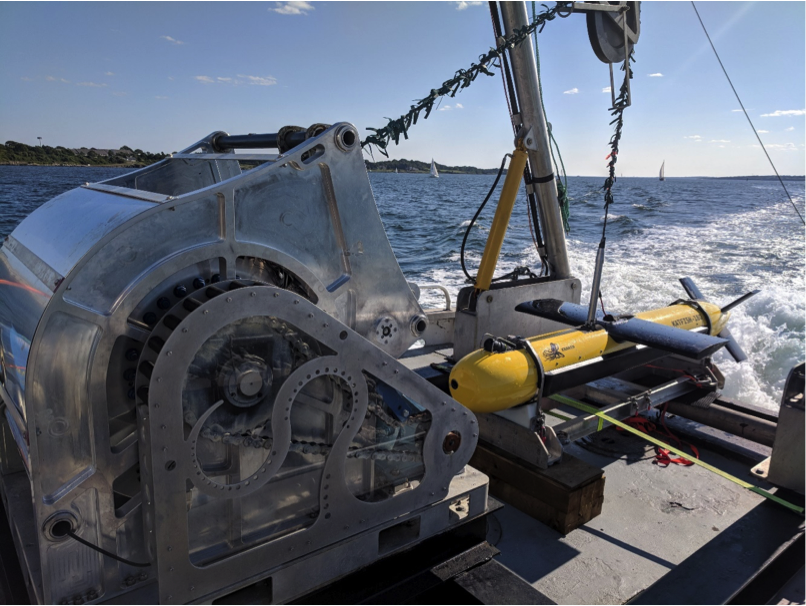
Kraken Robotics is highlighted as part of a proposed unmanned mine-hunting solution. The system would combine the MARTAC Devil Ray T38 autonomous surface vehicle, ThayerMahan’s Sea Scout Subsea Imaging System and a Pluto Gigas remotely operated vehicle. The Sea Scout system uses Kraken’s KATFISH synthetic aperture sonar to search the seafloor for mine-like objects.
The ThayerMahan Sea Scout Subsea Imaging System is specifically designed for missions such as mine hunting. The Sea Scout system is based on the in-production COTS Kraken Robotics KATFISH-180 tow-body mounted synthetic aperture sonar. The system is designed to search for mine-like objects and is integrated by ThayerMahan’s remote operations and communications system.
Combining commercially available, already-tested technologies could provide navies with an effective MCM capability faster than developing an entirely new system from scratch. Overall, it presents unmanned mine-hunting technology as an increasingly important capability for modern naval forces and identifies Kraken’s KATFISH as a key technology that could support these operations.
Article: The Indispensable Ingredient for Victory: Defeating Sea Mines