By Jeremy Hull, Canadian Defence Review
Kraken Robotics has become one of Canada’s fastest-growing marine technology companies. What began as a small startup focused on mapping the ocean floor has evolved into a global supplier of advanced subsea intelligence, autonomous systems, batteries, sensors and imaging technologies that support naval, commercial and scientific customers around the world.
That growth reached another level earlier this year. Today, Kraken employs approximately 1,200 people across eight countries and supplies critical technologies for some of the world’s most advanced autonomous underwater vehicles—a transformation driven in large part by a landmark acquisition completed just weeks before CDR spoke with Kraken Robotics.
When CDR interviewed Bernard Mills, the newly appointed President of Kraken Robotics, he was unusually well dressed for a casual Friday in mid-July. The occasion was an internal celebration marking a manufacturing milestone in the company’s new battery manufacturing facility in Halifax, which has been operational since the first quarter of 2026.
“We literally are the only company in the world doing deep sea batteries to the depths that we go,” said Mills. “We needed to replicate that capability and build on it in North America.”
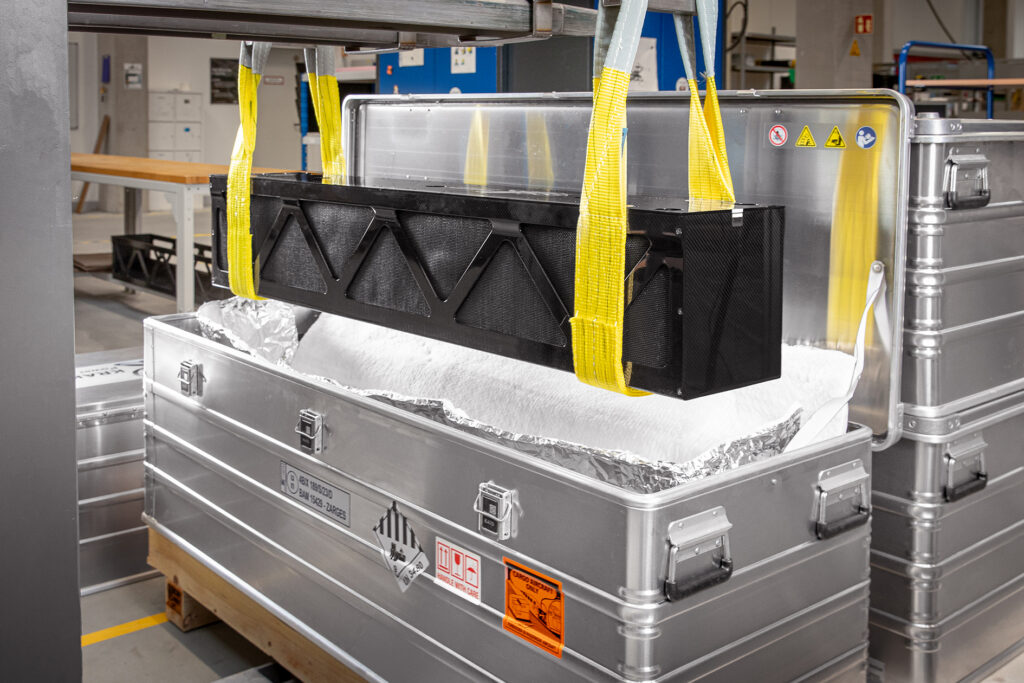
The Halifax operation was built to more than triple production of Kraken’s SeaPower batteries. The facility currently employs about 150 people in manufacturing and production support, with significant room for expansion as demand continues to increase.
“There’s obviously more and more customers coming online all the time around the world,” said Mills. “We’ve built a real flexible, scalable, multi-use facility that would enable us to hire that number of people easily again as the demand continues to grow.”
According to the company, Kraken’s SeaPower batteries provide 200 per cent greater energy density and 46 per cent less weight per kilowatt-hour than traditional alternatives. Those advantages increase the range and payload capacity of autonomous subsea vehicles, where every kilogram matters.
The Halifax facility also manufactures launch and recovery systems that support mine warfare operations conducted from autonomous surface vessels.
While the new plant represents a major milestone, it was quickly overshadowed by a much larger development that fundamentally transformed the company.
KRAKEN’S GROWTH SPURT
On July 2, Kraken acquired the U.K.-based Covelya Group for $615 million, purchasing five marine technology companies in a deal that nearly doubled revenue and almost tripled its workforce.
Covelya’s portfolio is anchored by Sonardyne, a 55-year-old leader in underwater positioning and communications. The acquisition also brought Danish maritime software company EIVA, Canadian optical imaging specialist Voyis (formerly 2G Robotics), U.K.-based environmental sensor manufacturer Chelsea Technologies, and naval defence systems company Forcys into the Kraken family.
The acquisition nearly tripled Kraken’s workforce, creating a company of approximately 1,200 employees operating across eight countries and increasing its 2026 revenue guidance to between $290 million and $320 million.
Prior to the acquisition, Kraken’s core strengths centred on its SeaPower battery technology and advanced synthetic aperture sonar systems. Covelya complemented those capabilities by adding navigation, positioning, communications and environmental sensing technologies, creating one of the broadest subsea technology portfolios in the industry.
One of the biggest integration challenges, Mills noted, is preserving the legacy of Sonardyne, whose reputation has been built over more than five decades. “We’re going to respect their legacy,” he said. “We’re going to celebrate the history and the market positions of those businesses. It wouldn’t make sense to do otherwise.”
Together, the combined technologies now account for as much as 80 per cent of the mission systems aboard some of the world’s most advanced autonomous underwater vehicles, including platforms operating in the Strait of Hormuz, the South China Sea and the Northwest Passage.
FROM SUBMARINES TO SWARMS
Kraken continues refining its synthetic aperture sonar to produce increasingly detailed underwater imagery while simultaneously miniaturizing many of its technologies for smaller autonomous and expendable platforms.
“What were traditionally quite large navigation systems are now being made into really small form factors,” explained Mills. “If you have drones that might only go in one direction, then you can provide capabilities for those sorts of applications.”
That evolution reflects a much broader shift in naval warfare.
“The last time Canada bought submarines, the role of the submarine was essentially a weapon platform; it goes out and fires torpedoes,” Mills told CDR. “Nowadays, something like a submarine or a warship is actually a node for swarms of other things to operate from.”
Kraken believes this transition presents significant opportunities, not only in military applications but also in protecting critical civilian infrastructure.
“This very interview, for example, is internet enabled and we know that adversaries are putting dormant devices on subsea cables,” said Mills. “We provide protection against those more low-key threats. They can really disrupt economies or disrupt our way of life.”
Protecting subsea infrastructure—which includes the communications cables that carry much of the world’s internet traffic—is becoming increasingly important alongside traditional naval missions.
“It’s not just about fighting wars,” he said. “It’s about keeping open sea lanes.”
Just four days after the Covelya acquisition closed, Prime Minister Mark Carney announced Germany’s TKMS as the preferred supplier for Canada’s Canadian Patrol Submarine Project (CPSP), which will deliver up to 12 new submarines for the Royal Canadian Navy.
SUPPORTING CANADA’S NEW FLEET
Although the Prime Minister did not disclose the program’s cost, he described the CPSP as the largest defence procurement in Canadian history.
Kraken is not a direct partner in TKMS’s submarine proposal, but Mills said the companies already have an established working relationship through minor warfare initiatives.
“We do have mine warfare related opportunities with TKMS,” he said. “The Canadian context TKMS needs because of the submarine deal will probably help our position.”
Kraken’s existing German operations—including a manufacturing facility employing more than 100 people and a sensor research group near Bremen—further strengthen those ties and position the company to benefit from deeper Canada-Germany industrial cooperation.
“Anything that bridges the Canada-Germany relationship even more is going to be a benefit to us,” he said.
As chair of the Canadian Association of Defence and Security Industries (CADSI), Mills also praised the government’s management of the submarine competition.
“I think both of the submarine contenders can indeed be races,” he said. “Either choice would have been excellent for Canada.”
GROWING THE SECTOR
Kraken’s transformation has coincided with a significant shift in Ottawa’s relationship with Canada’s defence industry.
“We’re now seeing levels of engagement, levels of support from Canadian government that, frankly, in my time in Canada, we’ve never seen.”
Recent examples include Secretary of State for Defence Procurement Stephen Fuhr and Defence Investment Agency CEO Doug Guzman attending the signing of a memorandum of understanding between Kraken and a Turkish shipyard in Istanbul. When Prime Minister Mark Carney and Defence Minister David McGuinty visited Australian counterparts earlier this year, Mills and Kraken CTO David Shea were present as participants in numerous government and industry exchanges on the agenda.
The company is also investing heavily in workforce development. Rather than competing for experienced employees, Kraken will be working with universities, technical colleges and community organizations to develop the next generation of subsea technology specialists.
“I think the industry is waking up to the fact that we need to start training a generation of people who are working high technology for Canada, moving forward,” he said. “The old ways… of just trying to poach from another company, that’s just musical chairs.”
From its beginnings as a Newfoundland startup mapping the ocean floor, Kraken has grown into one of Canada’s most significant defence technology companies. As its global footprint continues to expand, Mills believes the company’s future will ultimately depend on two things: the people it develops and its ability to continue innovating.
“We just need to keep innovating,” concluded Mills.
Article: From Seafloor to Global Force – Canadian Defence Review