
Constructing permanent structures on the ocean floor can be extremely challenging, and a change in plans can equate to millions of dollars in modifications and delays.
So how can offshore energy developers decrease risk to their budget and timelines when there are so many unknowns at the beginning of a project?
Kraken Robotics’ Acoustic Corer (AC) is a cutting-edge subsea survey system that bridges the gap between geophysical and geotechnical investigation methods by delivering high-resolution, 3D acoustic imagery of the sub-seabed.
By providing insight on the geology of the seabed, the AC can significantly de-risk off-shore development plans, saving developers from needing to alter designs due to geological hazards later in the installation process.
THE ACOUSTIC CORER TECHNOLOGY
The system comprises a suite of acoustic survey sensors which build up a high-resolution 3D acoustic volume below the seabed, within which, geo-hazards can be identified and geological units interpreted and correlated to geotechnical results.
These sensors include a high-frequency chirp operating at 4.5 kHz to 12.5 kHz, which enables the Acoustic Corer to identify boulders as small as 0.2m in the sub seabed, a low-frequency chirp operating at 1.5 kHz to 6 kHz, enabling penetration greater than 50m below the seabed, and a parametric transceiver, operating at multiple frequencies, which supports geological mapping.
By combining multiple sensors, the Acoustic Core produces a 14m diameter data set which penetrates the seabed. Depending on lithologies, penetration achieved is regularly down to >50m below the seabed.
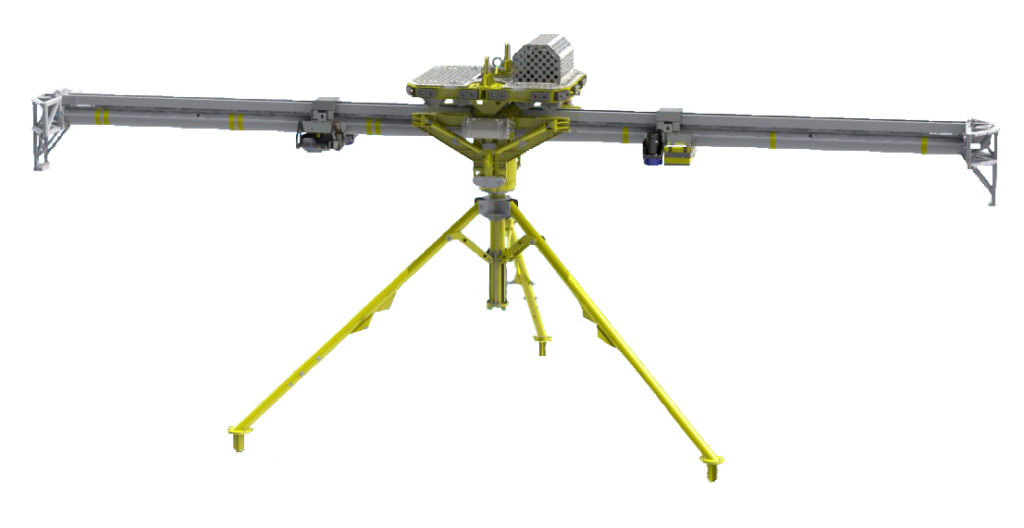
By measuring backscatter energy within the sub seabed, the internal patented processing system images the exterior of isolated anomalies such as boulders, producing centimetre accurate dimensions and XYZ location, whilst the parametric sensor provided lithological context, delineating boulder-strewn layers and providing geotechnical context. The system has been used across numerous industries for various applications:
DECOMMISSIONING
The Acoustic Corer can be used to locate deeply buried assets to confirm exact locations and integrity to support decommissioning plans. It has also been used to identify hydrocarbon leaks from buried conductors and flowlines.
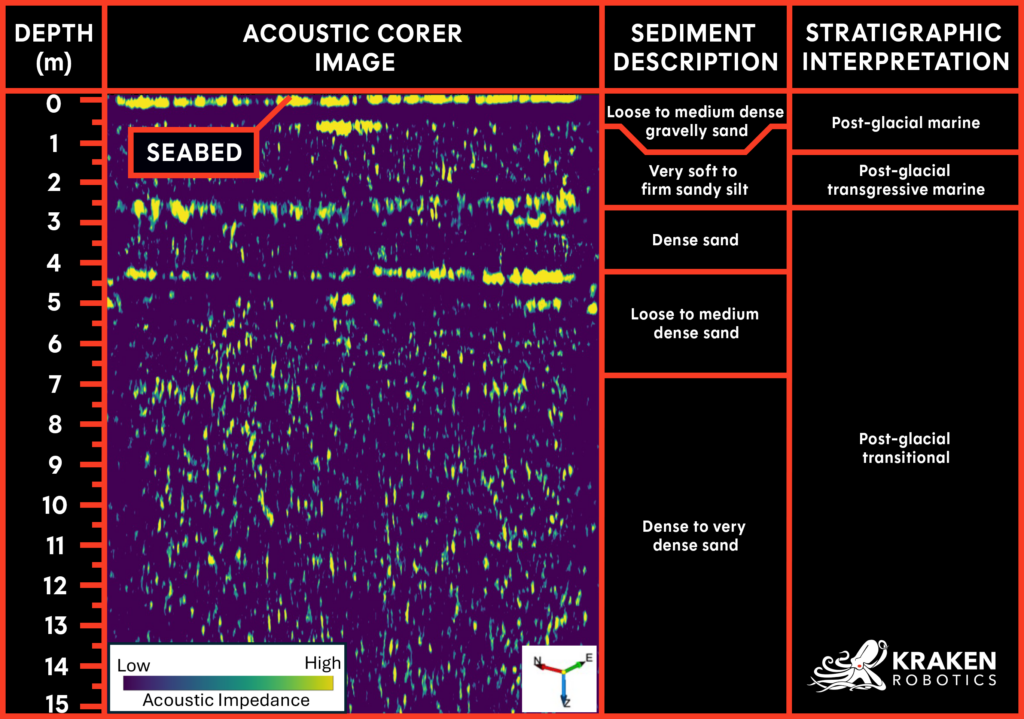
SITE INVESTIGATIONS
The Acoustic Corer enables identification of buried boulders >0.2m in diameter to depths in excess of 50m below seabed.
The data has multiple functions including the ability to support foundation design as well as foundation installation strategy and methodology.
The main application is the support to foundation installation campaigns to provide boulder locations, enabling micro siting of foundations or the risk to be appropriately managed and mitigated through engineering and installation methodologies, protecting schedules and costs from unforeseen soil conditions.
ABANDONED WELL LOCATION AND RE-ENTRY
The Acoustic Corer can accurately locate XYZ positions of abandoned wells with centimetre accuracy, assessing conditional integrity and presence of sub-surface debris and hazards.
Once acquired, preliminary results of the well position are produced offshore within 24 hours of data acquisition, enabling infield decisions to be made and initial risks or survey objectives reviewed, with final reports issued after demobilization.
Survey methodologies can be tailored to the project objective, from single scans at individual locations, triple overlapping cores which are merged into a single 3D volume to provide greater coverage and enable micro siting, or, for large areas, numerous overlapping cores can be acquired and merged into a large-scale 3D volume to enable regional ground models and wider geological context to be achieved.
PROJECT CASE STUDY – GENNAKER OFFSHORE WIND FARM BOULDER SURVEY
With its geographic location within the Baltic Sea, the Gennaker Offshore Substation (OSS) is in an area of complex seabed and sub-seabed conditions.
The purpose of this survey was to identify the presence of sub-seabed boulders with diameters of 0.2m or greater.
Previous towed 3D seismic surveys had failed to deliver the required resolution, therefore the client requested the use of the Acoustic Corer which, by combining High-frequency chirp (HF), Low-frequency chirp (LF) and Innomar chirp sources, can achieve market-leading resolution, penetration and accuracy. The aim of the project was to mitigate the risk of buried boulders to the safe and efficient installation of the two OSS, each with four caisson suction bucket foundations. The survey was required to map 0.2m diameter cobbles/boulders and penetrate to 15m below the seabed.
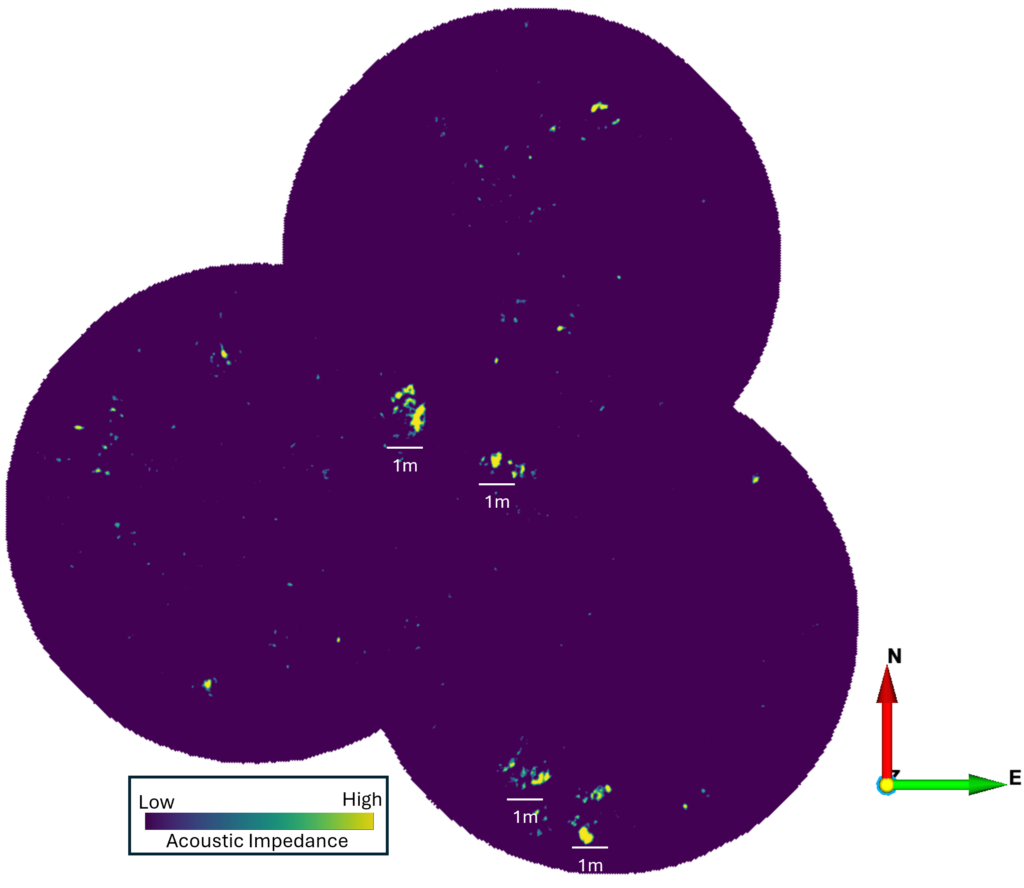
Plan view depth slice within a triple acoustic core showing anomalies suggestive of boulders.
Each leg location consisted of a triple acoustic core; three 14m diameter acoustic cores were collected and merged in a triangular pattern to form a single interpretable acoustic volume. Each acoustic core was laterally and vertically aligned to ensure a continuous response with no offsets between each acoustic core and the overlapping scans.
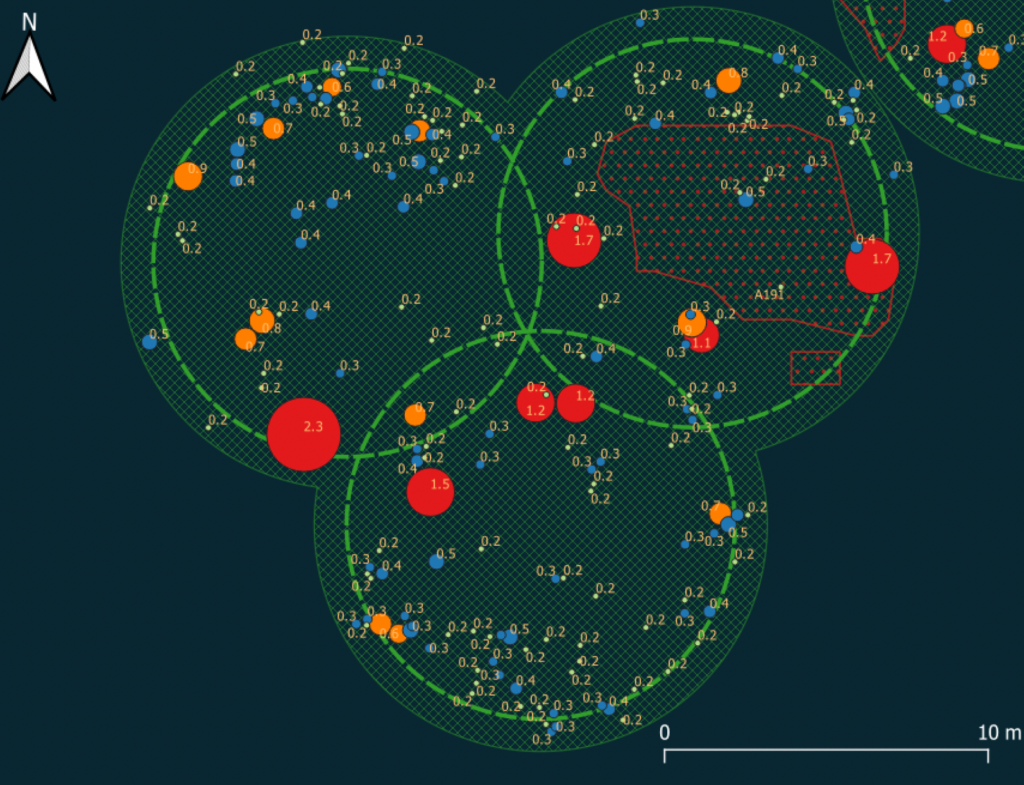
Triple acoustic core results compared to another 3D acoustic system’s results.
The hashed red area is from the other 3D acoustic system and the dots are the AC results.
The seabed and geological conditions were variable throughout the survey area, with the presence of seabed boulders and coarse sands. Despite the unfavourable conditions, the AC signal penetration was sufficient to resolve cobbles and boulders through the sediments, with a total of 1057 acoustic anomalies suggestive of cobbles/boulders interpreted across 24 scan locations.
Following the delivery of results, the client was able to ensure the design of the caisson suction buckets took into account the onsite geological conditions and that each pile would reach the required depth of penetration.
The foundations’ locations were also modified, rotating the OSS within the footprint of the 3D dataset to remove the risk of encountering cobbles/boulders during installation, enabling accurate installation forecasts and reducing the commercial risk to the project.
Having collected thousands of acoustic cores across North America, throughout NW Europe and the Baltics and Asia, Kraken Robotics’ Acoustic Corer reduces risk to offshore developers and increases sub-seabed clarity.
Article: De-Risking Subsea Installations With Kraken Robotics’ Acoustic Corer